Detailing Guide
Is Ceramic Coating Worth It for Idaho Drivers?
When ceramic coating pencils out for Caldwell drivers and when it doesn't — by vehicle value, ownership horizon, and storage condition.
You know how the conversation about paint protection usually goes.
A shiny new application sounds fantastic, but the upfront price tag naturally makes smart owners pause. Our team provides ceramic coating Idaho drivers trust, making it one of the most-asked-about services in the Treasure Valley.
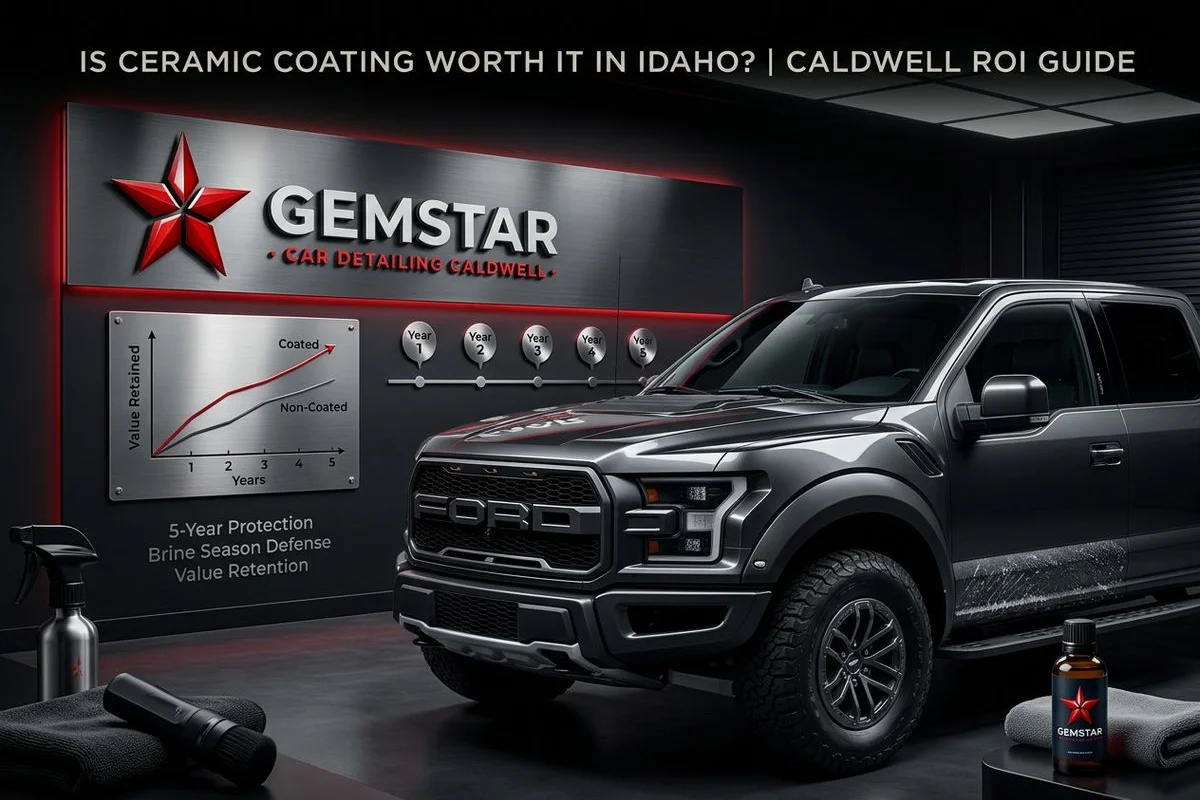
The honest answer to the question, is ceramic coating worth it, always depends on five distinct variables. This approach keeps expectations realistic and budgets in check. We are going to break down the exact math behind these factors so you can make an informed choice.
Let’s look at the actual data, what it tells us about longevity, and explore a clear framework for your vehicle.
Factor 1: Ownership Horizon
The single biggest factor in deciding if it is worth the cost is how long you plan to keep the car. A recent 2025 iSeeCars study found that the average length of new-vehicle ownership in the US has stretched to 8.4 years.
Our clients often realize that dividing a premium application over nearly a decade makes it significantly cheaper than annual detailing. You should view these applications as a strictly per-year cost.
Defaulting to a mid-range package is the safest bet if you feel unsure about your exact plans. We recommend matching the warranty tier directly to your planned timeline.
- Owning 1 to 2 years: A 6-month paint sealant or entry-level 1-year ceramic ($799) is usually the right tier.
- Owning 3 to 4 years: The 3-year ceramic option ($1,199) is highly economical, and the warranty matches your ownership.
- Owning 5 to 6 years: A 5-year tier ($1,899) is generally the sweet spot for daily drivers.
- Owning 7+ years: The 9-year flagship application ($2,499) starts to make incredible financial sense for higher-value vehicles.
Factor 2: Vehicle Value
Vehicle value plays a massive role in the return on investment. Kelley Blue Book data from early 2026 shows the average new car price in the US hovering right around $49,000.
Our installation bay sees plenty of these high-value investments rolling through daily. The math gets incredibly clear when you cross that national average threshold. Preserving resale value and reducing repaint risk scale proportionately with the underlying asset.
We break down the recommendations based on specific price brackets to simplify the choice.
- $15,000 to $25,000 vehicle: Ceramic is sometimes worth it, especially if you plan on keeping it 5+ years.
- $25,000 to $40,000 vehicle: This bracket presents a strong case for the 3-year or 5-year tier.
- $40,000+ vehicle: A 5-year or 9-year flagship application is usually a clear win here.
- $60,000+ vehicle: The 9-year flagship stands as the default choice to protect your equity.
The physical protection itself does not care about the vehicle value. The financial ROI absolutely does.
Our metrics prove that coatings preserve resale value extremely well.
Factor 3: Storage Conditions
Where the vehicle sits when you are not driving it dictates the urgency of the protection. Constant outdoor exposure makes an advanced coating one of the highest-leverage investments you can make.
Our local knowledge confirms that Idaho parking conditions vary wildly from neighborhood to neighborhood. The Ada County Highway District and Idaho Transportation Department heavily rely on liquid magnesium chloride and salt brine to treat priority routes.
This anti-icing chemical mixture is highly effective for public safety but incredibly corrosive to bare clear coats. We constantly remind clients that outdoor parking through brine season exposes vehicles to these harsh elements for months at a time.
- Garaged year-round: A coating still helps during use, but the urgency remains lower.
- Carport or covered parking: This option is solidly worth it for protection during active use.
- Outdoor parking year-round: Your car faces the brunt of the elements every day.
Factor 4: Brine Season Driving
The amount of time you spend driving through Idaho winters directly determines how fast a coating pays for itself. Heavy winter highway commuters see the absolute fastest payback period.
We look at the data and see Treasure Valley traffic averaging 40 to 60 minutes of brine-exposed driving per day in January. Magnesium chloride solutions can sit in highly alkaline or acidic ranges depending on the exact municipal mixture. Standard carnauba waxes strip away quickly under these harsh chemical conditions.
- Mostly stays in the garage in winter: The protection helps, but the overall urgency is lower.
- Daily-drive year-round: This routine makes the service worth strong consideration for any three-plus year ownership.
- Heavy winter highway commute: The five-year or nine-year tier is highly recommended because the severe brine exposure justifies it.
Our preferred professional coatings are engineered to withstand extreme pH levels from 2 to 14. This incredible chemical resistance creates a barrier that stops road salts from etching into the factory paint.
You will notice the difference during your first winter wash. We heavily factor your daily commute into our final recommendation.
Factor 5: Existing Paint Condition
A ceramic coating only locks in protection on healthy paint. It will not fix peeling clear coats or deep scratches.
Our detailing technicians always measure paint depth before quoting a job to tell you straight if the vehicle is a candidate. A massive mistake DIY enthusiasts make is applying a permanent layer without doing proper paint correction first.
Professional detailing forums constantly warn that applying these products over flawed paint traps the imperfections underneath for years.
We strongly advise against skipping this crucial preparation step. The transparent nature of the product acts like a magnifying glass for existing swirl marks and oxidation.
Minor imperfections require a light machine polish to create a flawless, glass-like surface. Our higher-tier packages include the right level of correction by default to ensure perfection.
Quick Decision Framework
This quick decision framework compares your vehicle value, ownership timeline, and driving habits to give you a clear recommendation. Use this table to quickly find the tier that matches your exact situation.
We designed this matrix to eliminate the guesswork from the process.
| Recommendation | Vehicle Value | Ownership Plan | Driving & Parking Conditions |
|---|---|---|---|
| Strong Yes | $25,000+ | 5+ Years | Daily-driver, outdoor parking, brine-exposed commute. |
| Probably Yes | $15,000+ | 3+ Years | Mixed parking, occasional brine exposure. |
| Maybe | Lower-value | 1 to 2 Years | Garaged storage, light brine exposure. (Consider a 6-month sealant). |
| Probably Not | Any Value | Selling within 6 months | Not using the coating to bump resale. (Pre-sale detail is better). |
The logic here is straightforward. A high-value daily driver takes a beating and needs a durable shield.
Our team consistently points clients toward a pre-sale detail if they plan to sell within a few months.
How to Decide
The cleanest way to finalize your choice is to get a professional evaluation based on your specific car. A personalized quote will lay out the exact costs and benefits.
We recommend having your year, make, model, and ownership plan ready. You can easily request a written quote to get the process started today.
The evaluation will specify the recommended tier and the necessary correction level. Our experts provide a realistic five-year ceramic coating roi comparison against annual waxing, all with a same-day turnaround. A beautiful finish requires the right strategy. Book your consultation to see the difference for yourself.
Related Service
Ceramic Coating
Ready to book this service in Caldwell? Get a same-day written quote.
Learn More About Ceramic Coating