Detailing Guide
Ceramic Coating vs Wax vs Paint Sealant
Three protection options compared on durability, cost, and Idaho performance — and which one fits which Caldwell driver.
We routinely see how Caldwell winters punish vehicle paint.
The average age of cars on American roads hit 12.5 years in 2026. Preserving that factory clear coat is now critical for retaining both resale value and a professional image for your business.
Our professional service team is here to break down your options. A proper comparison of ceramic coating vs wax vs sealant reveals three main layers of protection for Caldwell vehicles.
They sit in a clear hierarchy of cost, durability, and effort.
Wax (Carnauba and Synthetic)
We always explain to clients that wax is a traditional, temporary shield. What it is: A natural or synthetic wax sits on top of the clear coat as a sacrificial layer. Popular products like Collinite 845 liquid insulator wax deliver a beautiful shine but require frequent reapplication.
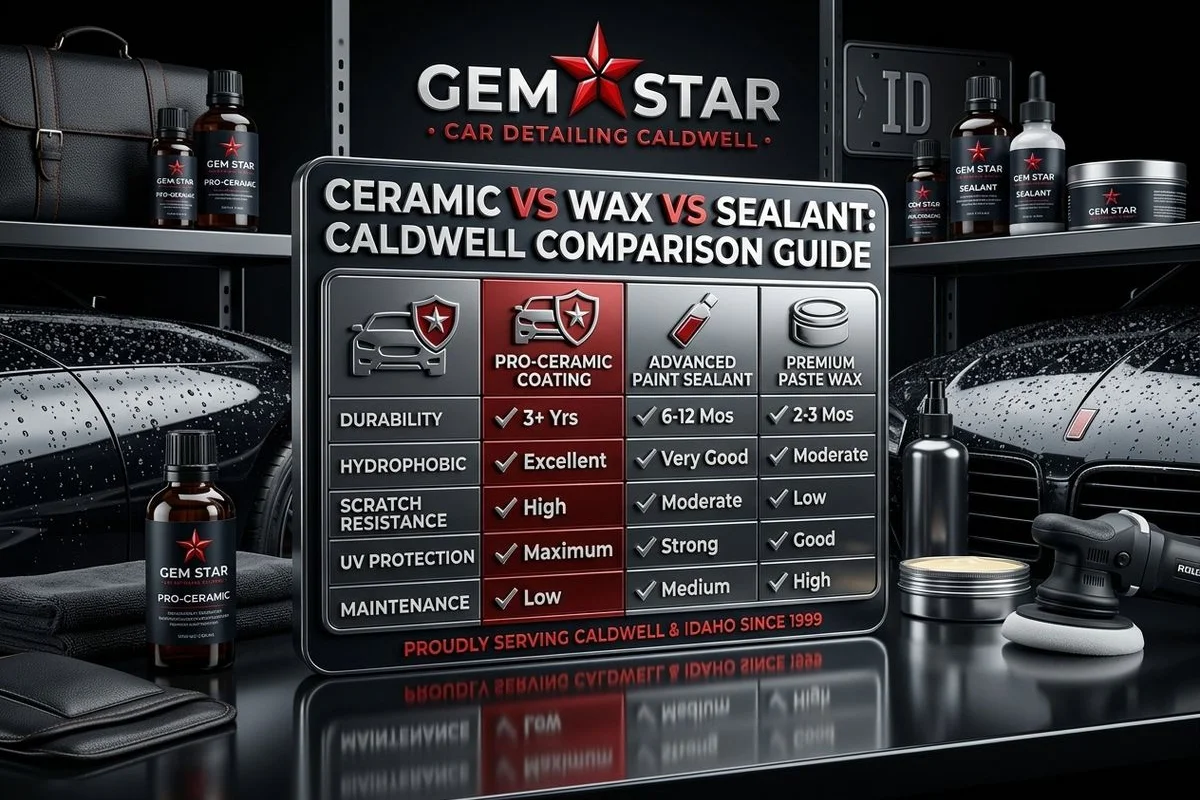
Our local climate quickly exposes the limits of these formulas. Lifespan in Idaho: Expect 1 to 3 months of coverage.
Magnesium chloride used on local roads is hygroscopic, meaning it pulls moisture from the air and actively strips wax away.
We find that intense UV exposure breaks down the remaining wax even further during the summer months. Cost: Budget $30 to $50 in DIY product per year, plus 2 to 4 hours of labor every quarter to apply. Best for: Garaged enthusiast vehicles, show cars, weekend-only vehicles, and owners who enjoy detailing as a hobby.
Our standard advice steers daily commuters away from this vulnerable option. Worst for: Year-round daily drivers in Caldwell because wax simply cannot keep up with brine season. Comparing the pros and cons makes the reality clear.
We ask customers to consider these factors:
- Pros: Wax provides a deep, warm gloss and remains easy to apply at home for a low cost per application.
- Cons: It has a very short lifespan and demands high cumulative effort.
Our clients often abandon it due to the significant drawbacks in the wax vs ceramic coating debate. The protection is completely inadequate for brine-season and strips off instantly in tunnel washes.
Paint Sealant
We consider paint sealants a solid middle ground for moderate protection. What it is: A synthetic polymer that bonds to clear coat more durably than wax to provide mid-tier defense. Industry favorites like Jescar Power Lock use advanced polymers to cross-link and form a tight barrier over the paint.
Our testing shows this bond holds up much better against environmental contamination. Lifespan in Idaho: Expect 4 to 6 months of realistic durability. It survives mild brine exposure but degrades with sustained UV rays and harsh wash chemistry.
We typically apply this twice a year to maintain peak performance. Cost: Expect to spend $40 to $60 in product per application. Best for: Mid-value vehicles ($15,000 to $25,000), drivers planning shorter ownership of 1 to 3 years, and clients wanting better-than-wax defense without a major investment.
Our premium and restoration exterior packages include this specific tier of protection.
- Pros: Sealants are significantly more durable than wax, highly affordable, and create a very hydrophobic surface.
- Cons: The material still degrades within a year and breaks down faster if exposed to tunnel washes.
Our team must remind customers that it still does not approach true ceramic durability when comparing paint sealant vs ceramic options.
Ceramic Coating
The next level up utilizes entirely different chemical engineering. What it is: A liquid based on silicon dioxide that chemically bonds to the clear coat, creating a thin, hard, hydrophobic layer.
We utilize these coatings to provide legitimate long-term protection.
Top-tier brands like Gtechniq cure to a 9H hardness level, meaning they resist micro-scratching far better than polymers.
Lifespan in Idaho: Expect 1 to 9 years of coverage depending on the specific tier, such as Gem Shield 1, 3, 5, or 9-year options.
Our application process ensures maximum adhesion for the full rated lifespan. Cost: Professional installation averages between $500 and $3,000 across the US in 2026. This price tag usually ranges from $799 to $2,499 locally, which includes the mandatory paint correction prep work.
We highly recommend this for vehicles that face daily commuting hazards. Best for: Daily drivers, year-round owners, vehicles valued over $25,000, and ownership horizons exceeding 3 years.
- Pros: You get multi-year durability, strong brine and UV resistance, manufacturer warranty backing, and a hydrophobic surface that significantly reduces wash time.
Our customers save countless hours of weekend scrubbing thanks to this slick barrier.
- Cons: It requires a higher upfront cost and professional installation.
Owners must also follow a specific aftercare protocol, meaning no tunnel washes and committing to biweekly hand washes.
Cost-Per-Year Math
We want to help you run the real numbers over a standard vehicle lifespan. The average length of new-vehicle ownership in the US reached 8.4 years recently. Comparing 5 years of protection in Caldwell reveals surprising financial realities.
Our breakdown accounts for both product expenses and the value of your free time.
| Protection Option | Annual Cost | Annual Labor | 5-Year Total |
|---|---|---|---|
| Wax (Quarterly) | ≈$200 in product | ~12 hours | $1,000 + 60 hrs |
| Sealant (Twice Yearly) | ≈$120 in product | ~6 hours | $600 + 30 hrs |
| 5-Year Ceramic | $0 after install | ~26 hours self-wash | $1,899 + washing |
Looking purely at the math, the per-year financial cost is roughly comparable across the board. A 5-year ceramic package costs a flat $1,899 single investment, includes free annual maintenance for year one, and demands just one hour for a biweekly self-wash.
We find that ceramic wins heavily on saving application labor hours, dominating brine performance, and maximizing resale value preservation. The choice becomes obvious when factoring in the massive 60 hours of waxing labor over that same period. The right solution simply depends on your specific vehicle and habits.
Which Fits Which Caldwell Driver
We match the protection strategy directly to how you use the vehicle.
- An owner of a garage-kept weekend enthusiast car can easily get by with wax or sealant.
- A daily driver planning a short 1-year ownership should stick to a sealant or a basic 1-year ceramic package.
Our highest volume requests come from people holding onto popular vehicles for longer terms.
- If you drive a $25,000+ daily commuter like a Toyota RAV4 and plan a 3+ year ownership, you need a 3-year or 5-year ceramic coating.
- A premium luxury vehicle, an expensive Ford F-Series work truck, or anyone planning a 7+ year ownership should invest in the 9-year flagship ceramic.
We always suggest pure wax for the deep gloss on a show car, but strongly advise layering a ceramic coating underneath if it gets regularly driven. Getting the right fit in the ceramic coating vs wax vs sealant choice protects your bank account and your paint. Review your driving habits to make the final call.
Related Service
Ceramic Coating
Ready to book this service in Caldwell? Get a same-day written quote.
Learn More About Ceramic Coating