Detailing Guide
Why Headlights Turn Cloudy and Yellow
The chemistry behind cloudy headlights, why Idaho's UV environment accelerates the problem, and what restoration actually fixes.
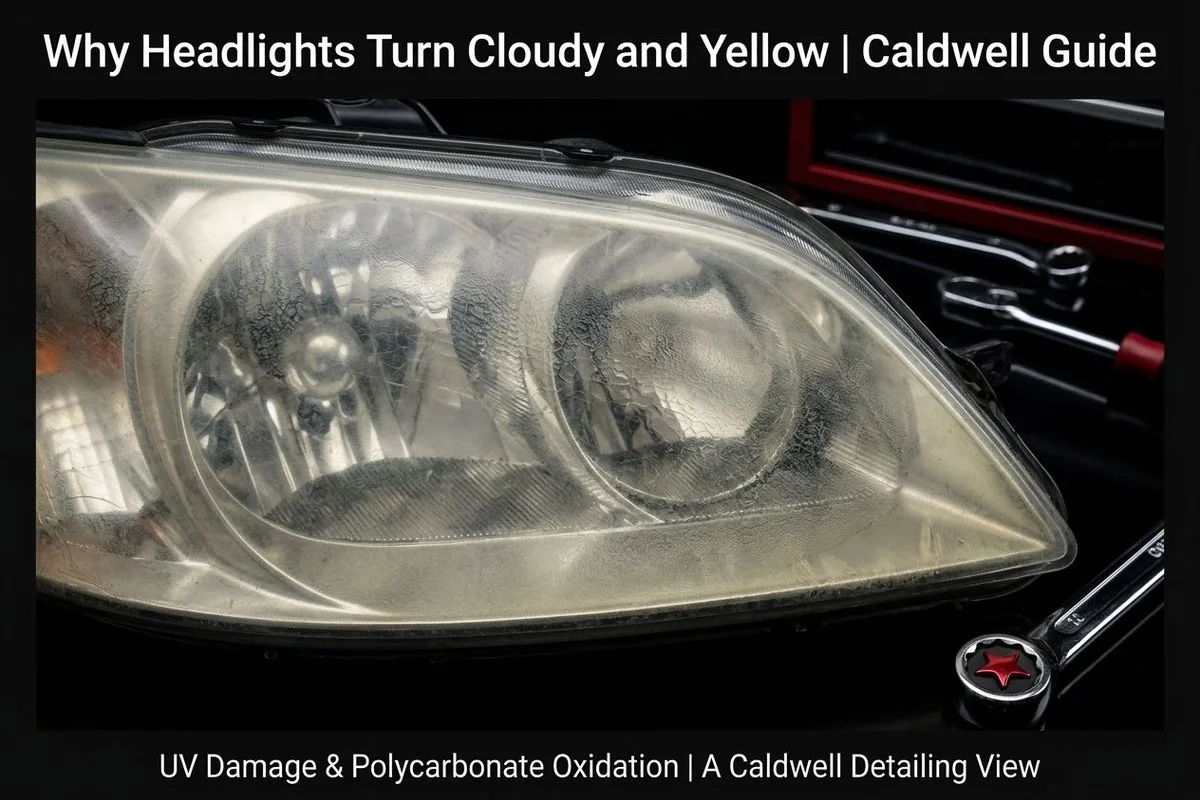
We see cloudy headlights in our shop every single week. Drivers constantly ask why are my headlights cloudy, and this problem goes far beyond an ugly cosmetic issue. A recent American Automobile Association study revealed that oxidized lenses can reduce your nighttime light output by a staggering 78 percent.
Our team knows this massive drop in visibility turns standard night driving into a serious safety hazard.
The chemistry behind this plastic degradation is simple to understand. You will easily spot the early warning signs once you know what to look for.
We will explain the difference between a cheap temporary fix and a true, long-lasting restoration. Quality information helps you make a better decision for your vehicle. Understanding the manufacturing materials provides a great starting point.
What Headlight Lenses Are Made Of
Our industry shifted away from heavy glass lenses decades ago to save weight and improve impact resistance. Modern headlight assemblies rely almost entirely on polycarbonate plastic. This tough material is optically clear when it rolls off the factory line.
We know that untreated polycarbonate would turn yellow in just a few months outdoors. The factory prevents this rapid aging by applying a thin UV-A protective hardcoat during the manufacturing process. This clear chemical shield is exactly what keeps your new car looking sharp.
Our local climate starts testing that protective layer the moment you drive off the dealership lot. That factory coating typically lasts five to eight years in moderate US environments. Heat and ultraviolet exposure gradually bake the protective layer away over time.
We see three key traits of polycarbonate lenses during every inspection:
- Excellent impact resistance: Prevents highway gravel from shattering the casing.
- Lightweight construction: Helps modern vehicles meet strict fuel efficiency standards.
- Poor natural ultraviolet resistance: Requires chemical sealants to survive daily sun exposure.
This chemical reality explains why every vehicle eventually faces lens degradation. The timeline simply depends on how much sunlight the car receives.
Why Are My Headlights Cloudy? What Oxidation Looks Like
Our technicians categorize this exterior oxidation into four distinct stages. The cloudy headlight reason always comes down to UV rays breaking down the exposed polymer chains. This structural degradation happens slowly from the outside in.
We often reference the American Automobile Association warning about “cataract headlights” obscuring the bulb completely. Most drivers fail to notice the gradual drop in illumination until it becomes dangerous. The progression follows a very predictable pattern:
- Initial stage: Light haze developing on the top edge, visible when oncoming headlights hit your car at night.
- Intermediate stage: Noticeable yellowing with nighttime visibility dropping significantly on unlit roads.
- Advanced stage: Heavy clouding taking over the entire housing with light output plummeting by 78 percent.
- Severe stage: Plastic cracking and crazing with housing seals failing and moisture pooling inside.
Our shop usually recommends a complete replacement if your lenses hit the severe stage. A completely destroyed lens housing simply cannot be saved safely. The plastic itself begins to splinter and break under any polishing pressure.
Why Caldwell Headlights Cloud Faster
We know that Caldwell headlights cloud faster due to extreme high altitude and intense daily sun exposure. Your specific location dictates exactly how fast your vehicle loses its UV coating. The harsh Idaho environment simply overwhelms the factory protection over time.
Our local data shows the average vehicle here develops first-stage haze by year five. The weather elements relentlessly assault the exterior clear coat every single day. Three specific Idaho factors accelerate the yellow headlights cause:
- High elevation UV radiation: Pushes more damaging rays through the thin atmosphere.
- More than 200 sunny days per year: Subjects the plastic to relentless solar baking.
- Magnesium chloride exposure: Creates harsh surface chemistry from US Mountain West winter road treatments.
We highly suggest parking in a garage whenever possible to extend lens life. Keeping the vehicle facing away from the afternoon sun also helps immensely. Simple preventative habits delay the inevitable oxidation process.
Why DIY Kits Don’t Work Long-Term
Our garage constantly gets visits from frustrated customers who spent hours scrubbing their lenses. Most store-bought consumer kits fail to provide a permanent fix because they lack a true UV-A curing hardcoat. They rely on mild abrasives and weak chemical sealants instead.
We know these cheap sprays bead water beautifully but offer zero structural UV protection. The problem lies entirely in the final step of the DIY kit. The protective liquid included in a cheap box is typically just a fast-evaporating silicone or wax polymer.
Our team completely agrees with a 2024 industry analysis confirming that raw polycarbonate is defenseless without a true UV-A curing hardcoat. The sun immediately resumes oxidizing the bare plastic without that chemical barrier. The lens inevitably turns yellow again within three to six months.
| Feature | Cheap DIY Kits | Professional Restoration |
|---|---|---|
| Primary Abrasive | Single grit sandpaper | Progressive wet-sanding (up to 3000 grit) |
| Protective Coating | Silicone spray or wax | Chemical UV-A hardcoat |
| Expected Lifespan | 3 to 6 months | 2 to 5+ years |
| True UV Blocking | No | Yes |
We refuse to use shortcut sealants because they cost you more time and effort in the long run. A real UV-protective topcoat bonds chemically to the polycarbonate for multi-year shielding. These commercial liquids require specific application conditions that basic consumer kits ignore.
What Professional Restoration Includes
Our technicians use a thorough process that takes about 60 to 90 minutes from start to finish. A proper restoration requires removing the dead plastic completely and applying a professional-grade UV barrier. The technician cures this chemical barrier at the very end to seal the work.
We follow a strict multi-step system to ensure maximum optical clarity. The preparation stage matters more than any other part of the job. The primary goal is to level the damaged surface perfectly before applying chemicals:
- Masking: Applying heavy-duty tape around the surrounding paint and trim.
- Wet-sanding: Working through 800, 1200, 2000, and 3000 grit abrasive papers to strip away oxidized polycarbonate.
- Machine compound polishing: Using a high-speed buffer and cutting compound to restore optical clarity.
- Refinement polishing: Running a finishing pad to eliminate any microscopic compound haze.
- UV-protective topcoat application: Bonding the chemical hardcoat directly to the fresh polycarbonate.
- Controlled curing: Letting the vehicle sit in a climate-controlled bay for 30 minutes to harden the shield.
- Final inspection: Testing the light beam pattern to verify maximum output.
Our shop guarantees the lens stays clear for years following this thorough method. The final light testing proves the dramatic difference in output. Your safety on unlit roads instantly improves when the bulbs can shine freely.
What’s Worth and Not Worth Restoring
We always evaluate the specific damage to determine if a restoration is your best move. Replacing modern headlight assemblies is shockingly expensive, making restoration the best choice for exterior haze. A 2025 parts cost analysis shows that average US replacement housings run between $150 and $800 each.
Our estimates for newer trucks with advanced original equipment LED projectors easily exceed $3,000 a pair. Some types of damage simply cannot be buffed away with sandpaper. The structural integrity of the housing matters just as much as the exterior lens clarity.
When Restoration Makes Sense
We absolutely recommend restoration if the damage is confined to the exterior surface. This minor wear includes standard light haze or intermediate yellowing. Clear headlights drastically improve buyer perception and resale value.
Our staff also suggests a quick restoration before listing a vehicle for sale. First impressions matter deeply to potential buyers looking at a used car. A clean lens implies a well-maintained engine to anyone inspecting the exterior.
When to Buy Replacements
We occasionally find structural failures during inspections that require a completely new housing. You need new parts if the internal seals fail and allow moisture or fog inside the lens. Deep cracks extending through the plastic also demand a total replacement.
Our mechanics will inspect your vehicle and give you a straight answer on the right call. Safety always comes before trying to save a few dollars on car maintenance. Driving with fully functional lights protects you, ensuring you never have to wonder why are my headlights cloudy when driving down a dark highway.
Related Service
Headlight Restoration
Ready to book this service in Caldwell? Get a same-day written quote.
Learn More About Headlight Restoration