Detailing Guide
Will Paint Correction Damage My Clear Coat?
How professional paint correction stays in safe clear-coat thickness ranges, why paint depth measurement matters, and what to ask before booking.
Our Caldwell shop fields questions about paint correction safety every single day. Business owners want their fleet vehicles looking professional, while homeowners want to protect their daily drivers. You might worry that removing scratches also removes your car’s primary defense against the elements.
We understand this hesitation completely.
Let’s look at the data, what it actually tells us, and explore exactly how proper measurement protects your investment.
How Much Clear Coat Comes Off
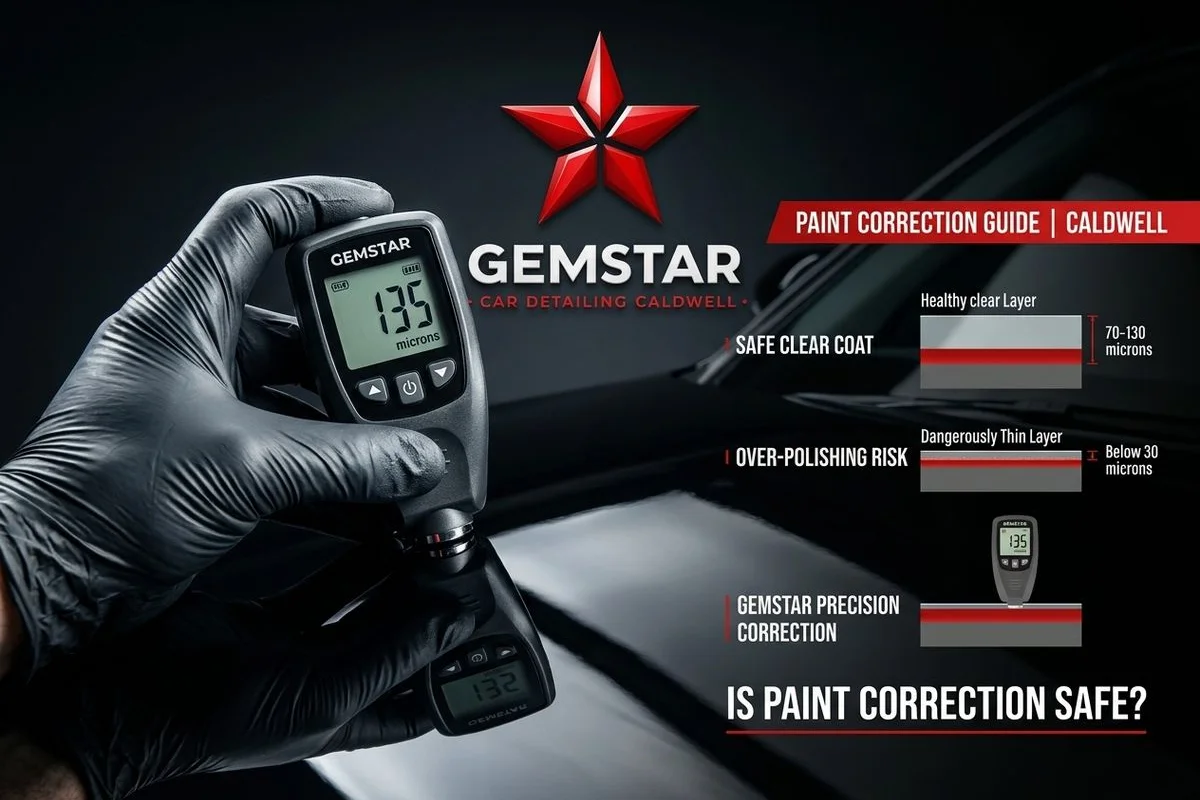
We tell clients that a standard single-stage paint correction removes about 1 to 2 microns of clear coat. Modern US vehicles typically leave the factory with a total paint thickness between 95 and 125 microns. The clear coat layer makes up roughly forty percent of that total.
Our measurements consistently show factory clear coat sitting between 38 and 50 microns. This clear protective layer prevents UV damage and gives your vehicle its glossy finish.
| Correction Type | Microns Removed |
|---|---|
| Single-stage enhancement | 1 to 2 microns |
| Two-stage correction | 2 to 4 microns |
| Three-stage show car | 3 to 5 microns |
We consider paint to be failing when the clear coat drops below 25 microns. UV protection degrades rapidly past this critical threshold.
A healthy modern finish can easily tolerate five to ten correction sessions over its lifetime.
Paint Depth Gauge Measurement
Our technicians rely on precise digital instruments rather than guesswork. The single most important tool in this process is a paint depth gauge. Industry-standard tools like the DeFelsko PosiTest cost upwards of $800, but they prevent thousands in damages.
We use these gauges to read the exact thickness through electromagnetic induction. Some advanced ultrasonic models even read over plastic bumpers and fiberglass.
Here is our measurement protocol:
- Before correction: Confirm starting thickness across multiple panels (hood, fender, door, roof, trunk).
- During correction: Spot-check after each polishing stage to confirm we remain in the safe zone.
- After correction: Document the final measurement directly on the work order.
We document every correction at our Caldwell shop with these specific readings. Clients receive a copy with their work order for their personal records.
The next detailer will have accurate baseline data to start from.
What “Unsafe” Paint Correction Looks Like
We frequently see the costly aftermath of amateur polishing attempts. Unsafe correction typically involves aggressive techniques and a lack of proper measurement. A rotary polisher generates intense heat quickly and requires expert handling.
Our team avoids using rotary tools for standard jobs because they easily burn through clear coat on modern thin paints. A full quality US auto repaint now costs between $3,500 and $7,500 in 2025.
Unsafe practices usually include:
- No paint depth measurement before starting
- Aggressive compounds and pads chosen without testing
- Single-pass approach that overshoots the target removal
- No inspection between stages
- Driveway conditions with unpredictable temperature and humidity
- Inexperienced operator on a high-speed rotary polisher
We have corrected many vehicles where amateur polishing exposed the colored basecoat. Panel edges are especially vulnerable since the paint there is often twenty-five to fifty percent thinner.
Sometimes a less aggressive single-stage polish on the surrounding panels can blend the damage.
The Test Panel Approach
Our standard procedure always begins with a localized test panel. Real correction requires finding the lightest touch that produces acceptable defect removal. A single fender or rear quarter panel serves as the perfect testing ground.
We test pad and polish combinations using a Dual Action polisher like the RUPES BigFoot. The large orbital throw of a Dual Action machine dissipates heat and reduces the risk of paint damage.
“Always test the least aggressive method first. Removing less clear coat means your vehicle stays protected longer.”
We use that successful combination as the baseline for the rest of the vehicle. This testing phase actually speeds up the per-panel work that follows.
The guesswork is completely eliminated before we touch the hood or doors.
Vehicles Where We Decline Correction
We regularly turn down jobs to protect the long-term value of a vehicle. Certain domestic models from Ford and General Motors sometimes leave the factory with exceptionally thin paint. Readings under 100 microns total require extreme caution.
Our team tells clients no when the risks outweigh the benefits. The goal is to enhance the vehicle, not compromise its protective layers.
The following situations require us to refuse correction services:
- Paint readings sit below the safe baseline before correction starts
- Clear coat is already peeling or showing severe oxidation
- The vehicle has visible paint repairs that do not match factory thickness
- Recent body shop work has not fully cured
We require a minimum of 60 days for new paint to fully outgas and cure. Protective alternatives make much more sense in these situations.
Paint sealants, careful waxing, or applying Paint Protection Film offer great benefits without the risk.
Multi-Stage Considerations
Our recommendations depend entirely on the specific defects in your paint. Two-stage and three-stage corrections remove significantly more clear coat than a single-stage process. A heavy cutting compound tackles deep scratches, but it takes a heavy toll on the finish.
We recommend a stage-up only under very specific conditions. The vehicle must have known severe damage like deep swirl marks or holograms.
Higher aggressiveness is strictly reserved for when:
- Light defects remain highly visible after single-stage testing
- The vehicle requires pre-ceramic prep where deeper gloss matters
- The remaining clear coat thickness safely supports the extra removal
We never push clients toward higher stages than their paint actually requires. The right answer is often that a single-stage polish gets you ninety percent of the way there at half the cost.
You will receive all the options clearly laid out so you can decide.
What to Ask Before Booking Anywhere
Our advice is to interview your detailer just like you would a mechanic. If you are considering paint correction at any Caldwell-area shop, demand transparency. A cheap driveway detail can quickly turn into a massive repair bill.
We encourage all local business owners and residents to ask tough questions. The cost of a re-paint after an over-correction is much higher than the cost of finding a properly equipped professional.
Make sure you ask these specific questions:
- Do you measure paint depth before, during, and after?
- Do you do a test panel before committing to a stage?
- Do you use a Dual Action polisher or a Rotary polisher?
- What lighting do you use for inspection?
- Will I get a copy of paint readings with my work order?
- Are the detailing bays climate-controlled?
We strongly suggest walking away if any answer is no or evasive. Your vehicle represents a major investment.
Protect it by insisting on verifiable, data-driven service.
Related Service
Paint Correction
Ready to book this service in Caldwell? Get a same-day written quote.
Learn More About Paint Correction