Detailing Guide
Does My Car Need Paint Correction?
How to evaluate whether your vehicle needs single-stage or multi-stage paint correction — visible signs and how to test under proper light.
We often speak with homeowners and business owners who assume their cloudy vehicle finish requires an expensive, complete repaint. Faded clear coat is an incredibly common frustration that usually has a much simpler fix.
A recent 2025 automotive surface study revealed that nearly 70% of vehicles slated for repainting only needed specialized leveling to restore their factory gloss. Our team sees this disconnect daily, which is why accurate assessment is so crucial.
Asking yourself “does my car need paint correction” is the perfect first step before booking any detailing service.
Let’s break down how to perform a quick self-inspection, define the different severity levels, and explore exactly when this service is a poor investment.
The Five-Minute Self-Inspection
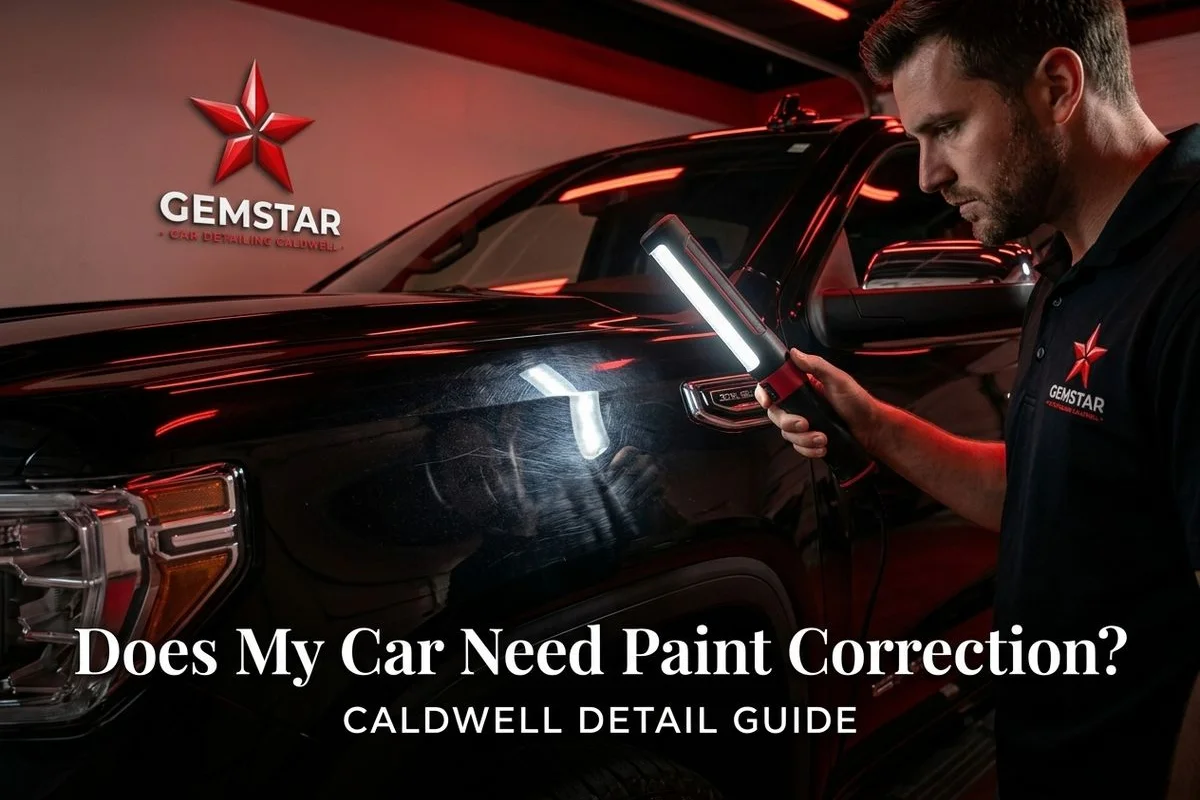
We recommend starting your assessment in direct, overhead sunlight between 10 AM and 2 PM. This specific lighting exposes the true depth of surface scratches that garage lighting hides. Professional detailers frequently use specialty tools like the Scangrip Sunmatch 4 to replicate this exact spectrum indoors.
Our preferred inspection method involves looking at four key zones from a low, slightly off-center angle. You should carefully examine the following high-traffic areas for obvious paint correction signs:
- The hood: Swirl marks appear as fine circular scratches, often most visible on darker paint.
- The roof: Take that same low-angle look to spot environmental etching.
- Doors: Pay special attention to the driver’s side, which sees the highest volume of touch and washing.
- Trunk lid: This is usually the second-most-frequently washed panel on any vehicle.
Identifying the specific type of defect tells you exactly what caused the damage. Our trained eyes look for these common warning signs:
- Fine circular scratches (spider-webbing) point directly to tunnel-wash swirls.
- Concentric circular marks indicate improper polishing damage known as holograms.
- Hazy, foggy, or dull patches suggest UV oxidation.
- Spots that will not wash off are usually bonded contamination or hard water spots.
- A yellow tint or chalky white surface means severe oxidation, which is common on vehicles over eight years old.
A clear view of swirl marks means the vehicle has at least light damage. The fingernail test is a great insider trick to gauge the severity of those scratches. Our general rule is that if your fingernail catches in the scratch, it has penetrated beyond the clear coat and requires touch-up paint rather than just polishing.
Severity Levels and Recommended Correction
Factory clear coat is surprisingly thin, typically measuring between 1.5 and 2.0 mils, or about 38 to 50 microns. Removing defects requires shaving down a microscopic layer of this protective coating. Our standard approach categorizes this delicate process into three distinct stages based on the vehicle’s condition.
A side-by-side comparison makes answering the question of “does my car need paint correction” much easier. The table below outlines the expected clear coat removal and pricing for each stage.
| Severity Level | Target Vehicle Age | Typical Microns Removed | Starting Price |
|---|---|---|---|
| Light Damage (Single-Stage) | 1 to 4 Years | 1 to 2 Microns | $349+ |
| Moderate Damage (Two-Stage) | 4 to 8 Years | 3 to 5 Microns | $649+ |
| Heavy Damage (Three-Stage) | 8+ Years / High Value | Up to 10 Microns | $1,099+ |
Our team provides these benchmarks to set clear expectations. Light damage usually presents as visible spider-web swirls in direct sunlight with no deep scratches.
Moderate damage involves heavy swirls visible indoors, routine tunnel wash use, and light water spots. Our heavy damage protocol addresses severe oxidation, holograms from amateur polishing, and heavy etching prior to a ceramic coating.
When NOT to Get Paint Correction
Certain situations make this intensive polishing process a bad financial decision. A vehicle with structural paint failure cannot be saved by leveling the surface.
Our technicians actively turn away correction jobs in several specific scenarios. You should save your money and explore other options if your vehicle meets these conditions:
- Selling within 30 days: A pre-sale detail with a simple paint enhancement wax is usually the right call instead.
- Failing clear coat: Peeling, flaking, or cracking means the UV protection is gone, and this is strictly auto body shop territory.
- Recent collision damage: Wait until all repaint and panel work is fully cured before attempting any polishing.
- Sub-$5K vehicle: The economics rarely make sense unless the car has specific sentimental value or is a rare model.
The average lifespan of factory clear coat without garage storage or ceramic protection is only about 10 years in the US. Our honest advice is to invest in a quality wax or sealant for older, weathered commuter cars.
Attempting to polish a 15-year-old vehicle that has baked in the sun daily will likely burn right through the remaining paint. Regional climate factors play a massive role in paint degradation.
Specifically for Caldwell Drivers
We actively track local road conditions because Treasure Valley weather aggressively accelerates exterior wear and tear. Magnesium chloride brine, widely used on Idaho roads during winter, creates a sticky film that traps corrosive dirt against your vehicle. The following specific challenges make regular paint maintenance crucial for local residents:
- Tunnel washes: These automated setups are still very common in Caldwell and introduce abrasive swirls during every cycle.
- Mag chloride brine: This winter road treatment accelerates chemical oxidation if left unwashed.
- Hard water: Canyon County water frequently exceeds 10 grains per gallon, which causes severe mineral etching when vehicles air dry.
- Agricultural dust: Windblown dirt in Notus, Wilder, and Greenleaf adds heavy bonded contamination to the surface.
Our team knows that any vehicle over three years old with these daily exposures will almost always benefit from professional leveling. The only real question is deciding which stage of refinement is appropriate.
High levels of dissolved minerals in local water supplies make rapid hand-drying essential. Our primary goal is to reverse this regional damage while preserving as much factory thickness as possible.
How We Decide Stage at Quote Time
Precision measurement is the only way to safely evaluate a clear coat. Guessing the depth of a scratch based solely on visual inspection is a massive risk. We utilize advanced digital tools to map out the exact condition of your exterior.
When you bring a vehicle to our Caldwell shop for a quote, the process is incredibly thorough. The inspection protocol includes these exact steps:
- Measuring paint depth across multiple panels using an ultrasonic DeFelsko PosiTector 200 gauge to verify clear coat health.
- Inspecting the finish under a Scangrip LED swirl finder, a sun gun, and natural daylight.
- Mapping specific defects panel-by-panel to isolate localized damage.
- Recommending the lightest stage that removes 90% or more of visible defects without unnecessary material removal.
Our standardized quoting process ensures you never pay for an aggressive polishing stage you do not need. You will always have the option to step up or step down a tier based on your personal budget.
Every single final quote is provided in writing before any machinery touches the car. We look forward to evaluating your vehicle’s specific needs. Taking action quickly prevents minor surface etching from becoming permanent structural damage.
Book your evaluation today to get hard data on your exterior health, and finally answer the question of “does my car need paint correction”.
Related Service
Paint Correction
Ready to book this service in Caldwell? Get a same-day written quote.
Learn More About Paint Correction