Detailing Guide
Why RVs Develop Oxidation and How Detailing Reverses It
How gel coat oxidizes on travel trailers and motorhomes, why Idaho conditions accelerate it, and what oxidation removal actually involves.
We see exactly how hard Treasure Valley RVs work every single season.
From what we have observed, standard gel coat simply cannot survive prolonged exposure to Idaho weather without specialized care. Cascade summers, Payette Lake weekends, and 200 days of intense UV quickly degrade standard camper finishes.
Our technicians frequently tackle rv oxidation removal to save outdoor-stored rigs from permanent damage. This guide explains exactly why that chalky haze happens and the specific steps required to permanently restore your finish.
Let’s look at the data on why this degradation occurs and walk through the exact professional methods used to protect your investment.
What Gel Coat Is
Gel coat is a specialized polyester or epoxy resin layer that forms the shiny exterior of your travel trailer or motorhome. Our team explains to clients that this material is applied during manufacturing with embedded colors and UV stabilizers.
It is roughly three times thicker than a standard automotive clear coat. This specialized material provides several key benefits:
- Resists minor scratches better than thin automotive paint.
- Houses embedded color pigments for a uniform look.
- Contains chemical UV stabilizers to slow down sun damage.
We know this extra thickness helps the exterior handle heavy outdoor exposure much better than standard paint. However, the gel coat still oxidizes over time.
Our experience shows that UV stabilizers eventually wear out, causing the resin matrix to break down. The result is a chalky rv exterior that most outdoor-stored Caldwell RVs develop by year five to seven.
Why Idaho Accelerates Oxidation
High elevation and abundant sunshine combine to rapidly break down RV finishes in our region. We frequently see rigs deteriorate much faster here than they do in coastal states.
Three major factors compound the damage:
- High UV at altitude: Our local Caldwell elevation naturally increases UV exposure compared to sea-level cities. According to the Skin Cancer Foundation, UV radiation increases 4 to 5 percent with every 1,000 feet of elevation.
- Mountain destinations: We notice that trips to Cascade or Payette Lake push your rig past 5,000 feet. This exposes the gel coat to 20% to 25% more intense UV radiation than a sea-level baseline.
- Outdoor storage: Our local environment includes over 200 sunny days a year. Many Caldwell RVs sit outside year-round, getting full UV plus winter brine exposure.
A garage-stored Phoenix RV might easily go ten years before showing significant wear. Our shop routinely inspects outdoor-stored Caldwell RVs that need complete rv gel coat restoration by year five.
What Oxidation Looks Like
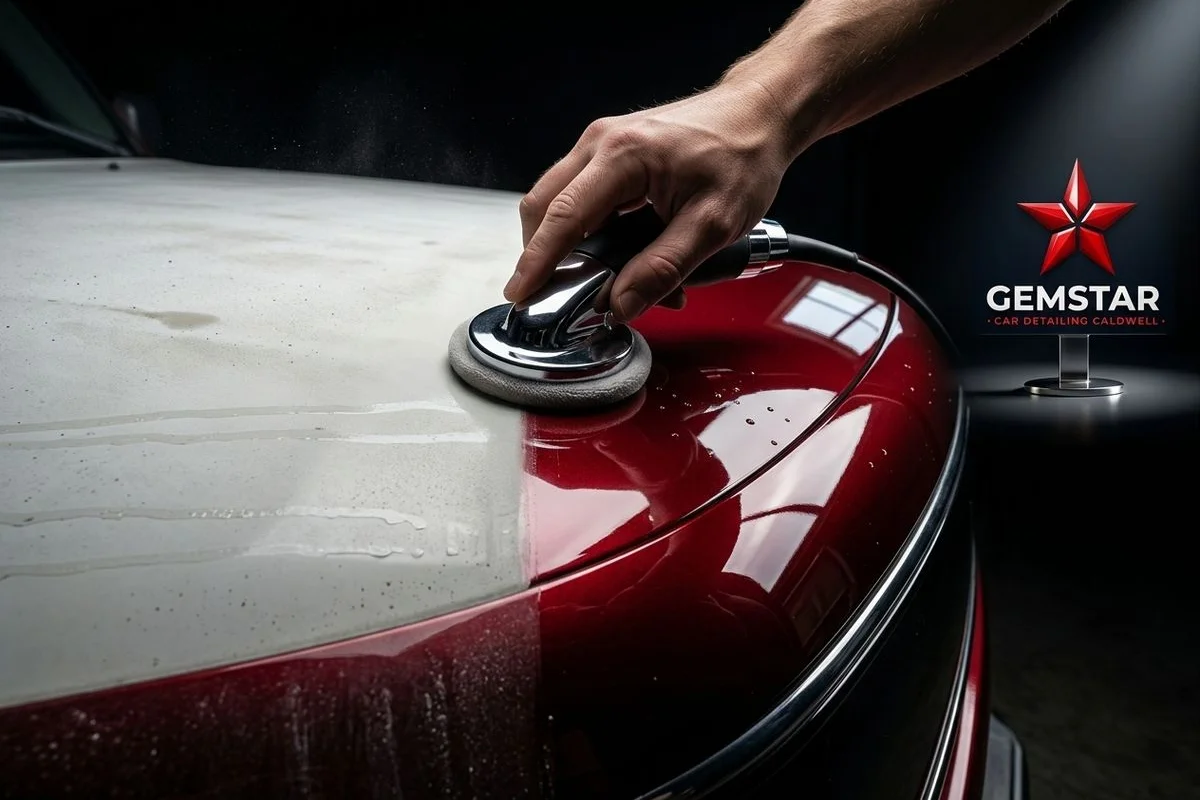
Oxidation begins as a slight haze and eventually progresses into a rough, white powder. We categorize this degradation into four distinct stages to determine the right fix.
- Light: A slight haze forms on the surface. You will find this difficult to see except in direct comparison to a freshly polished section.
- Moderate: Visible dullness sets in. We usually feel a slightly rough texture when running a hand across the side. Wiping the surface leaves a light residue on your skin.
- Heavy: A thick, chalky white powder coats the surface. Our technicians see this most often on upper sidewalls and the forward cap that face the sun. The resin has noticeably degraded at this point.
- Severe: The underlying color fades visibly. We often find areas where the resin has cracked or crazed entirely. Restoration might not be possible, requiring professional panel repair instead.
Our Restoration Process
The severity of the damage completely dictates the appropriate repair technique. We approach every project by matching the abrasive compound and pad type to the exact condition of the fiberglass.
Using standard automotive tools on a camper is a common mistake that yields poor results. Our detailing crew relies on marine-grade products designed specifically for porous gel coats.
Light Oxidation Treatment
A single-stage polish easily handles early-stage hazing. We use a light cutting compound followed immediately by a high-quality marine wax. This procedure usually combines into our Wash & Wax tier.
Moderate Oxidation Treatment
Visible dullness requires a two-stage polishing approach. We perform a heavier compounding pass to remove the dead, oxidized layer. A refining polish then follows to restore the original deep gloss.
Our technicians finish the job by applying a protective marine wax or marine ceramic. This level of work typically falls under our Restoration tier.
Heavy Oxidation Treatment
Chalky surfaces demand a highly aggressive three-stage polish. We use specialized rotary buffers with wool pads and heavy-duty chemicals like Meguiar’s M49 Marine Oxidation Remover.
Soft foam pads can actually trap polish inside the porous gel coat and create a frosted look, so proper tool selection is critical. Our process includes the heavy compound, a refining polish, and a final sealing pass. Marine ceramic is highly recommended at this stage to lock in the correction.
Severe Oxidation Treatment
Cracked or completely faded resin requires a case-by-case evaluation. We measure the remaining gel coat thickness to see if the rig is safely restorable.
Sometimes the underlying resin damage is simply too extensive for buffing. Our team will report honestly if panel replacement is a better financial choice.
Per-Foot Pricing
Detailing costs generally range from $15 to $35 per linear foot across the US, depending on the severity of the damage. We avoid publishing flat rates because RV conditions vary drastically from rig to rig.
The table below outlines typical pricing based on vehicle size and oxidation level.
| RV Size & Type | Oxidation Level | Estimated Price Range |
|---|---|---|
| 24-foot Travel Trailer | Moderate | $799 to $1,199 |
| 30-foot Motorhome | Moderate | $1,099 to $1,499 |
| 35-foot Fifth Wheel | Heavy | $1,499 to $2,200 |
| 40-foot Class A Motorhome | Heavy | $2,500+ |
Our customers can also choose optional finishing packages. Standard marine wax adds $200 to $400, while a multi-year marine ceramic coating generally adds $1,500 or more.
Protection After Restoration
Leaving a freshly polished gel coat unprotected guarantees the chalky haze will return within a single season. We stress that Idaho UV rays will start ruining the raw finish in a matter of weeks.
Owners must choose between two distinct protection paths to seal the surface.
Traditional Marine Wax
Carnauba-based marine wax serves as our basic protection option. We find that this coating provides reliable defense for about four to six months under direct sun.
It is highly affordable but requires consistent, annual reapplication as part of a pre-season detail. Our team recommends this economical approach for most Caldwell owners with mid-range trailers valued between $40,000 and $100,000.
Marine Ceramic Coating
A professional marine ceramic coating acts as a permanent, two-layer shield against UV exposure. We use marine-specific ceramics that chemically bond with the fiberglass, unlike standard automotive coatings that sit on the surface.
Products from brands like FEYNLAB or Glidecoat extend the protection window to a massive three to five years. Our shop highly recommends this investment for Class A motorhomes, luxury fifth wheels over $80,000, and any unit stored fully outdoors.
The upfront cost is significantly higher, but the product quickly pays for itself by eliminating annual waxing fees.
Roof and Slide-Out Considerations
Sidewalls represent just one part of the equation, as roofs and slide-outs often suffer accelerated UV damage. We make sure to address every exposed surface during a full correction service.
Oxidation attacks these components in different ways:
- Roof surfaces: Gel coat or rubber roofs degrade much faster than sidewalls due to direct, overhead sun exposure. A thorough roof clean and seal inspection is automatically included in our Restoration tier.
- Slide-out exteriors: These sections experience completely different exposure patterns depending on how often the rig is parked open. Slide-out treatment is included on our Ceramic packages and quoted separately on Restoration packages.
- Awnings: Fabric and vinyl awnings accumulate heavy UV damage and require entirely separate cleaning chemistry to prevent cracking.
Our crews check all four of these critical areas during Restoration and Ceramic appointments. Routine maintenance on these upper sections prevents costly water leaks down the road.
Fixing a faded RV requires heavy labor, specialized marine products, and a deep understanding of fiberglass. We enjoy turning chalky, neglected campers back into glossy, road-ready vehicles.
Catching the problem early keeps the repair costs manageable and protects the underlying resin.
Related Service
RV Detailing
Ready to book this service in Caldwell? Get a same-day written quote.
Learn More About RV DetailingRelated Guides